Bones Break Us Open

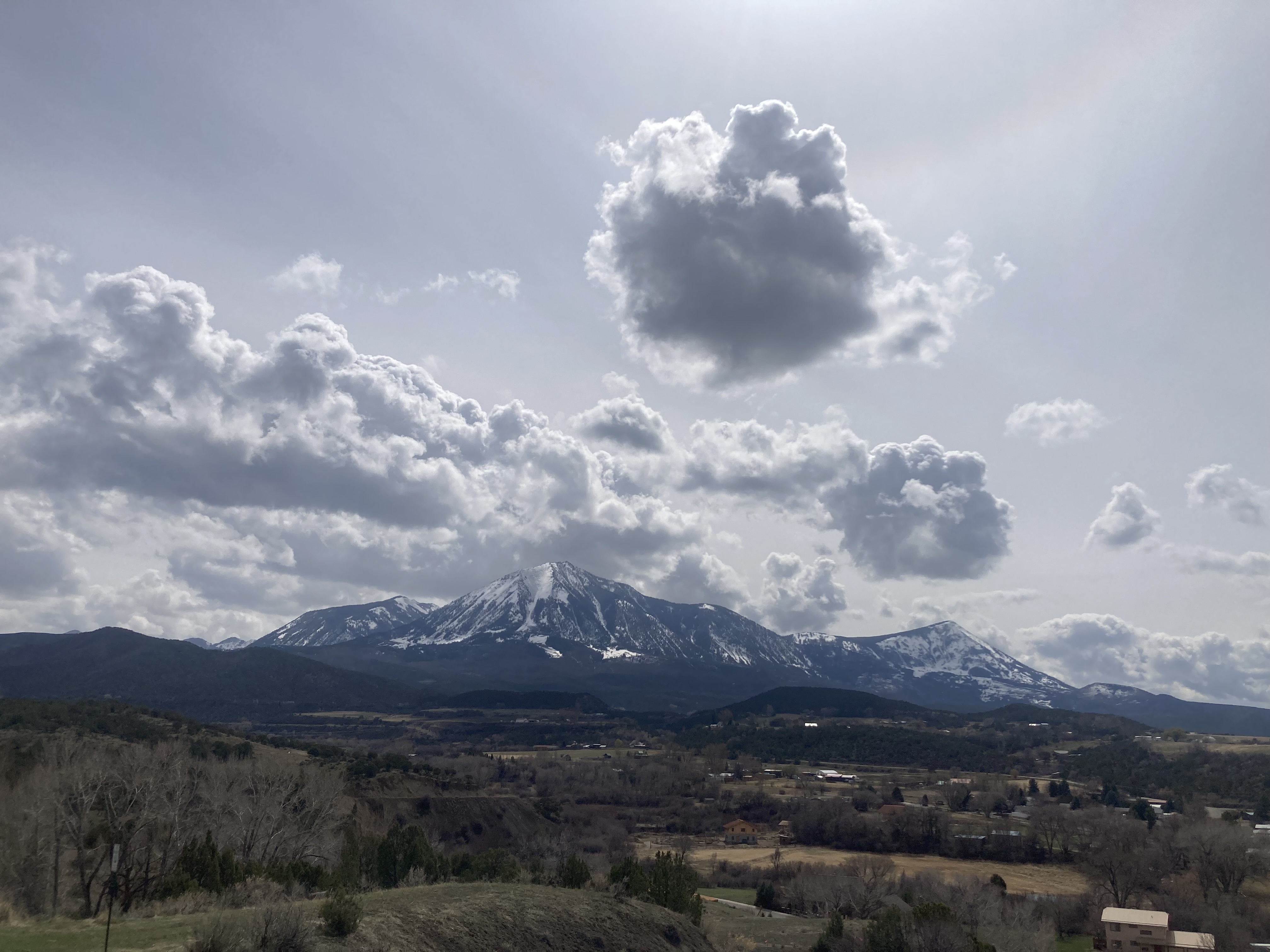
Just back from visiting a friend on Bone Mesa on the far side of Colorado, where snowy peaks towered over the mesa. Deer grazed on grass shoots at twilight. Blossoms from wild apricots blew along the dirt road like fallen stars. 

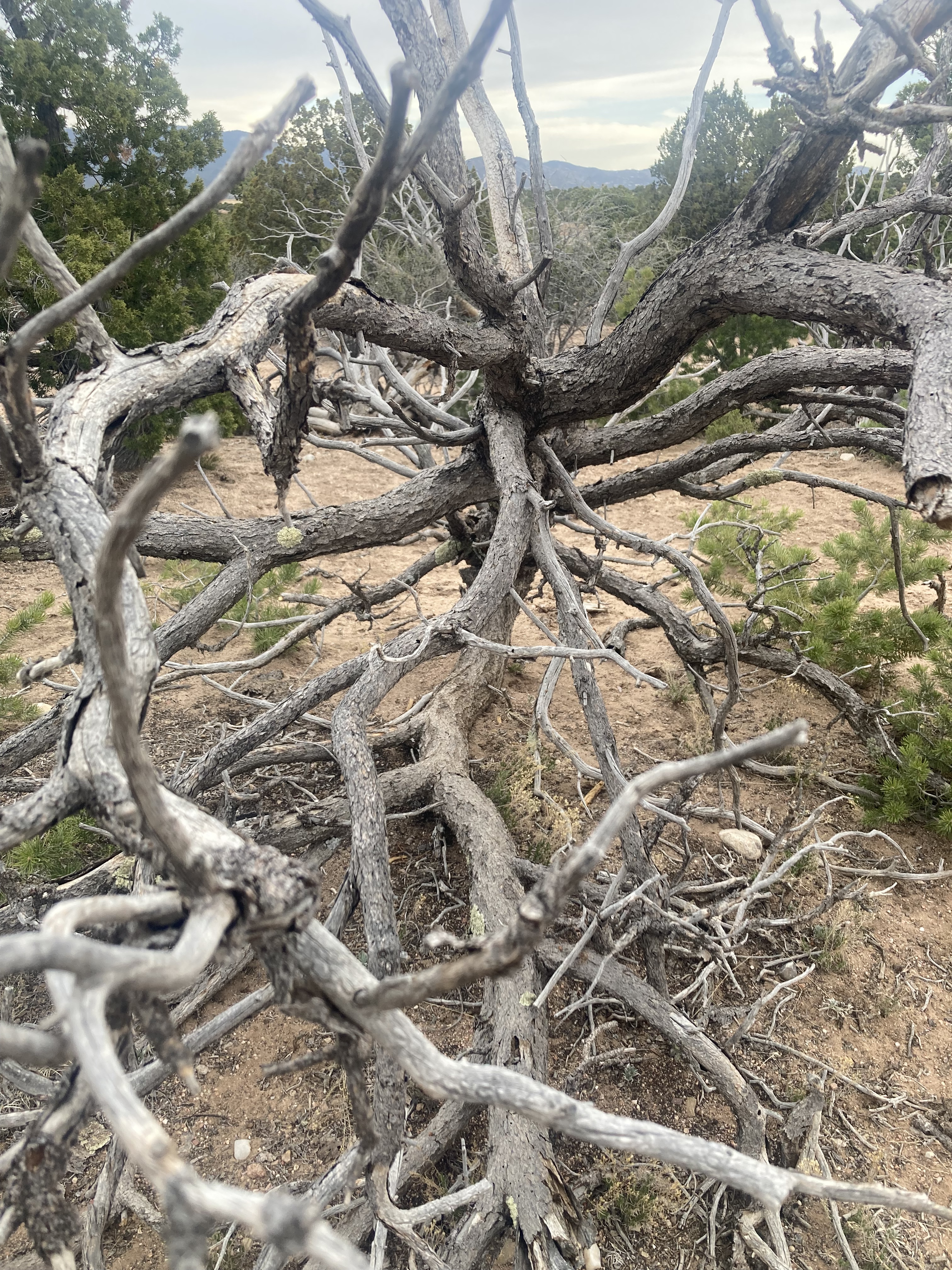
A poem practically wrote itself, in that moment. Except I didn’t write it down, but rather wandered around inside it, as happens when we realize we are actually walking through a poem, we are the poem, that the mesa is really bones, and the bones are poems.

My friend served lentil stew and fresh bread. A fire roared in the woodstove. The night grew transparent as a veil that the wind can lift, revealing that we aren’t in this world at all, but in the place where imagination lives, where we are fed on earth and stones. Where bones speak.

Bones more or less open Far Country, and in an invocation that may or may not have to do with every word that follows, we are reminded in the first poem that it is “Better to ask / what these bones will hatch, what lies, / curled, inside the shells of the dead.”

In “Blood City,” the ground we walk upon cobbled in fossilized snakes curled into balls, which turn to eggs. I can’t say that I always understand what the images that enter my poems say, but I trust and obey them. My friend and fellow writer Jennifer Ferraro read those lines as a call to perceive more deeply, to open our field of awareness to the memory of the land.

When I check my copy of The Book of Symbols, it says that bones suggest that something “hard” within psychic life endures beyond bodily death, and that a structure of ancestral experience supports us. In the Orthodox Church, the sweet smelling bones of saints are venerated as holy relics that bless us. Bones as bearers of life. Benediction and medicine.

Bones accompany the poet/speaker/me throughout the book–as talisman and key. There is an underworld called The Boneyard to be navigated. And in every poem, there is an invisible skeleton holding it up that is not, entirely, of this world.

The earth is a realm of bone on bone, in all the ways that can be understood. It can hurt to be here, magnificent as the scenery might be. Throughout the struggles, bones remind us that something unseen supports us, lies hidden within the known world, bears new life within what is buried.

Soul Boats: Poems as Vessel

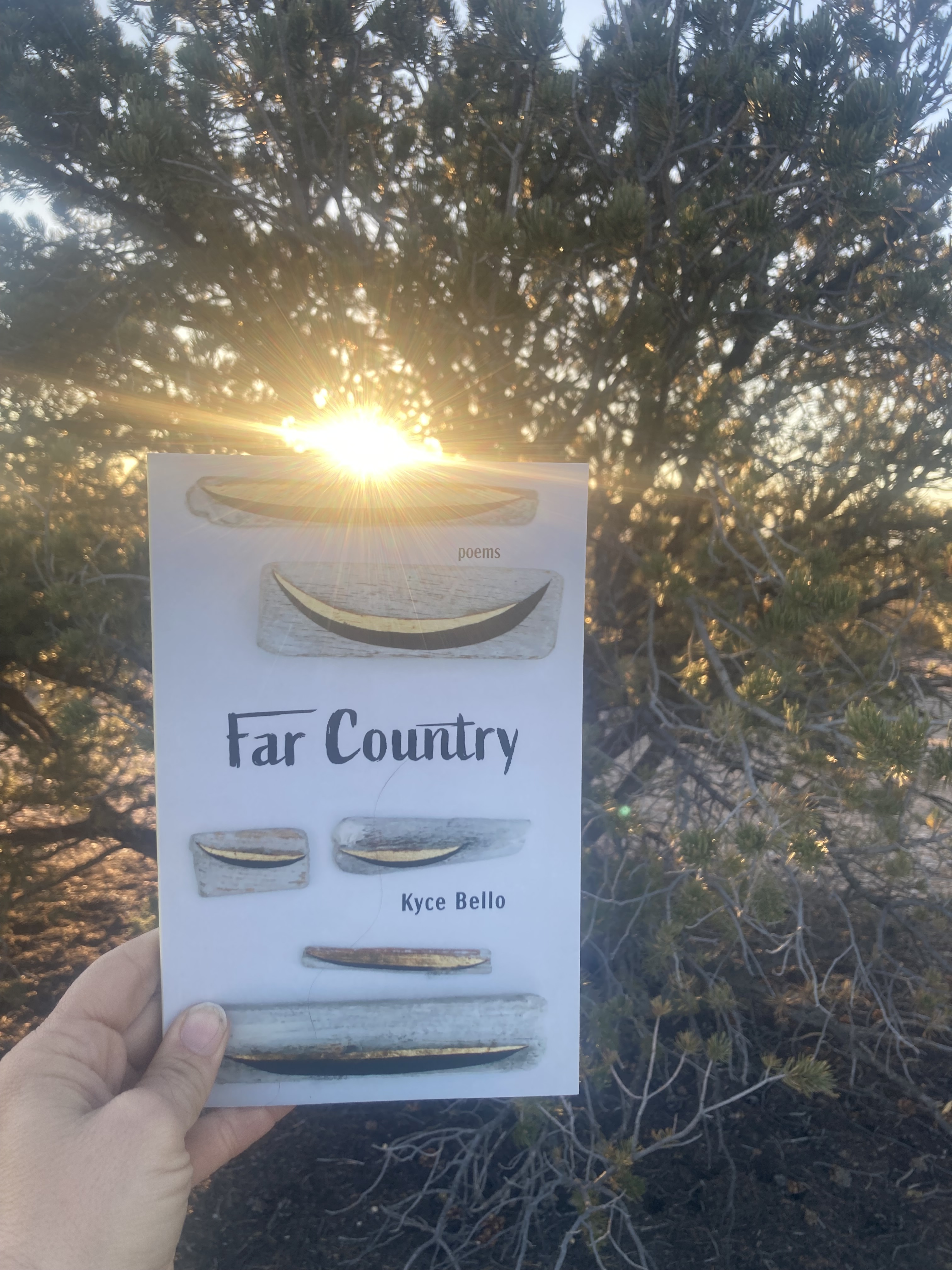
Cover art  ‘Bardsey Boats” ink and gold leaf on found wood from Bardsey Island, 2017 by Jake Lever.

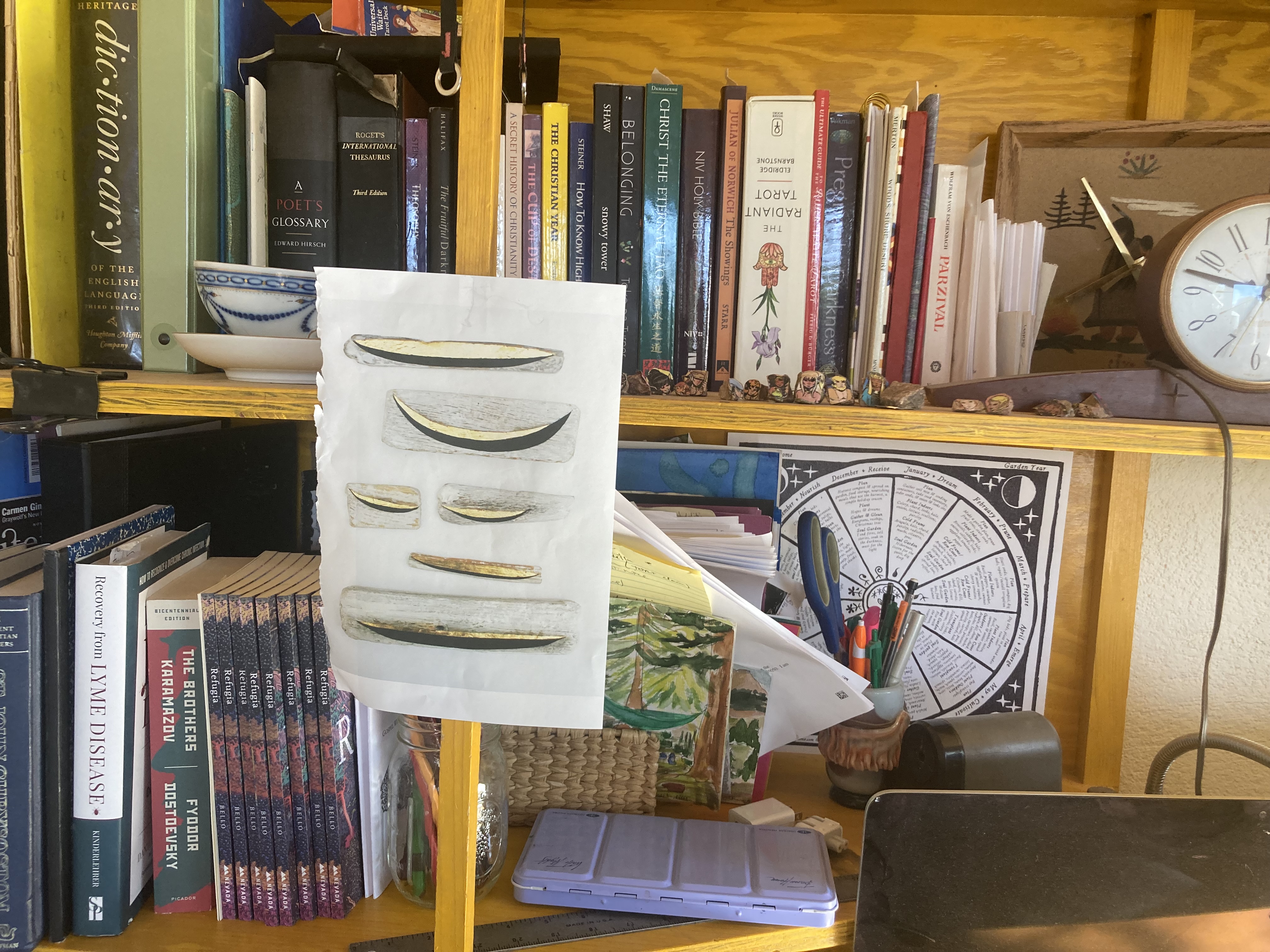
I encountered the boats on the cover of Far Country in Soul on Deck, a story in Image Magazine about their creator Jake Lever and his series of installations called “Soul Boats.” It was love at first sight. I tore the page with the fleet of Bardsey Boats out and pinned it over my desk. They became a beacon as I wrote and re-wrote this book.

As letters “written” in symbolic language, these boats seem to me not so much image as an invocation, a means of engagement, a mode of travel. For how else can one reach the distant lands promised in the title Far Country? Particularly given that they aren’t exactly places one can reach in ordinary ways.

My draw to the image was strengthened by Jake’s description of the process behind their creation, as described in the Image Magazine story:

Jake Lever’s artist statement in Image Magazine

I love this example of art making via deep engagement with place and its inherent mythologies, a process of seeing, exploring, collecting, shaping, marking, sharing. What beautiful instructions for artists working in any medium. It makes me wonder, how can my poems engage directly and tangibly with the place they arise from? What is it they might offer to others, or back to the land? What can they listen for in the silence? Where might they travel?

As you can see, I was deeply struck by Bardsey Boats, a response that doesn’t surprise their creator. In a recent email, Jake wrote to me,

“Simple pre-industrial boat forms seem to get “under the door” and seep into the soul like no other image.  There is something primal around the vessel cradling/nurture/protecting at birth and yet offering safe passage across the threshold from life into death. All very mysterious, primal and wonderful – beyond intellect and more to do with intuition, ancestors and spirit life.  They have given me so much and I am still learning from them.”

From Soul on Deck, Image Magazine. Another of Jake’s boats, on a much larger scale, with sage advice from CPE we might all carry us with us right now.

Boat as imagination, as consciousness, as body. These are the things that carry us across the deep waters of life. These boats helped me to recognize the ways in which this book is about loss, change, and grief on many levels–the transformations we face in our individual lives, the large scale ecological shifts taking place around us, and the collective atrocities and unraveling we are amidst.

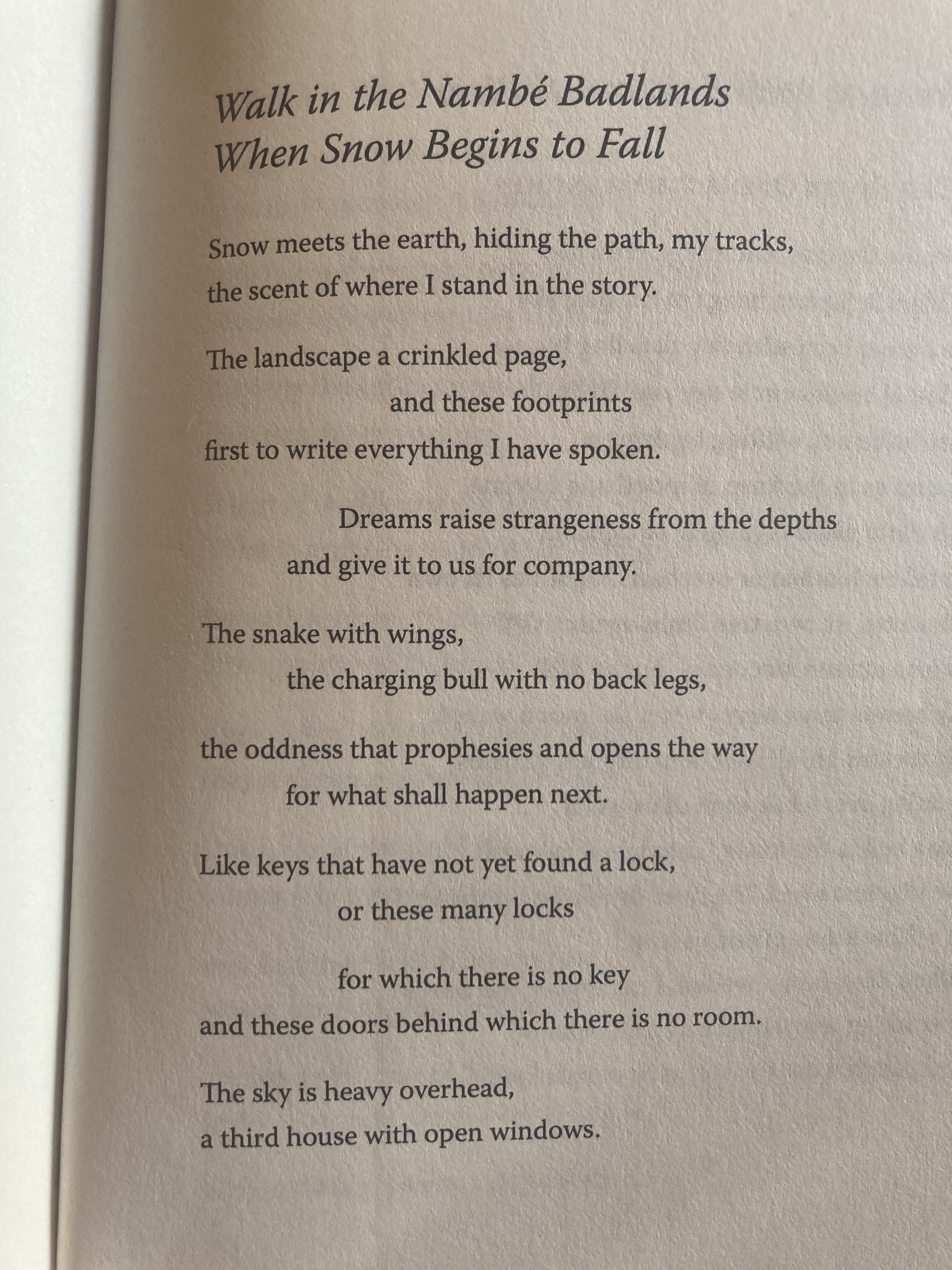
Perhaps the boats are keys, or symbols that open the way. Adorning a book cover, they become the door that is literally opened. Given how much time the speaker in many of these poems spends looking for doors and keys, that is fortuitous indeed.

Pinned over my desk as I worked on the manuscript.

Visually, the Bardsey Boats appear to me as a poem—perhaps each is word in a gloriously spare poem, or a stanza made of thin couplets descending down the page. Or perhaps each one is an individual poem, and they are a sequence in which the image shape shifts and transforms.

Most of all, I love the reversal of this image—to imagine each of the poems in Far Country becoming a boat. A vessel, a fleet of vessels like these inked and gilded bits of driftwood.

May they, too, carry the reader between worlds.

::

Out of the Depths: Introducing Far Country

Here I am, friends, like an underground river rising to the surface once again. The occasion is a celebration: my new poetry collection, Far Country, arrives into the world March 4th thanks to University of Nevada Press. Oh, happy day!

(Cover art Bardsey Boats, from the beautiful series of “Soul Boats” by Jake Lever. )

Please join me in person or virtually for the official book launch at Collected Works Bookstore Wednesday, March 12 at 6pm. The event will include a reading from Far Country followed by a conversation with the wonderful poet and friend to the earth, Anne Haven McDonnell. I am so excited to see where we go together…

Well, what can I tell you about this newborn book?

Five years in the making, these poems are my attempt to explore the unknowable–a landscape transformed by climate change, motherhood turned into crucible, and the unmapped territory in which loss becomes a medium of deepening connection and love.  

There are poems about herb lore, the imaginal realm, the flourishing earth. It’s filled with signs from the stars and the moon, and a new relationship to faith taking shape quietly in the background. There is a midwife, a daughter in trouble, and other wounded healers. There are deer. Springtime, for sure. There is drought and dry rivers, and moths. There is heartbreak and mercy. There are loads of keys.

“Far Country” refers to the world we have left behind, the future we are hurtling towards, and the foreign, disoriented present. It is the ground we stand upon when we have lost our bearings. It is a place of spiritual exile, longing, and return. To reach there, these poems traverse worlds both seen and unseen, fusing them into a rich tapestry of lyric exploration and wonder.

I invite you to travel to those lands and walk alongside me for a bit. Far Country is available from your favorite independent bookseller.

::

Given the long lapses I’ve had writing here, I have come to see this space, once so wide ranging and free flowing, as an ephemeral river. Perhaps it flows under the surface during dry years, or gets diverted to other channels, or drops into other dimensions entirely, like the rio abajo rio that lies out of sight even as it waters our souls from the depths.

But now, to honor the arrival of this new book, I have in mind a brief season of posting a companion guide to the poems. Things like the practice of poetry as numinous art, what it means to write “ecologically,” the crucial role of imagination in these times, and other landmarks I used to navigate into and out of Far Country. Oh, and I can’t wait to tell you more about those beautiful boats on the cover.

I hope you’ll join me. Subscribe for best coverage! We’ll see what the river picks up in its meandering, and what it has to carry up from the silence underground.

Confluence: On Creativity and Motherhood

Last month, my e-friend and mothering and soapmaking mentor, Renee of FIMBY, published a wonderful e-book called Nurturing Creativity: A Guide for Busy Moms. This little book is my cup of tea: inspiring, rejuvenating, down to earth, and only three bucks. It’s like manna, royal jelly, and super blue green algae all mixed up into a power bar for the creative soul. Yup, that nourishing. She writes, “My dream for this book is to tend the garden of your creative spirit.” And it’s true. This book is like a rich load of compost followed by a long soaking rain (or a week of sun, for those of you non-desert dwellers). While she was writing this book, Renee asked me and a few other bloggers about our experience balancing creativity and motherhood. She was looking for about a hundred words on some specific questions, but once I started writing I found I had a great deal to say on the subject. This the gist of it:

Confluence

Before I had children, I spent much of my time crafting poetry and fiction and nonfiction. In those days, I believed that writing was the most creative and important thing I could do with my time. When I was pregnant for the first time and just wanted to sit and dreamily crochet granny squares for a baby blanket, it felt almost like a waste of my creative energy. Shouldn’t I be doing something “real” like writing a poem? A good friend reminded me that however lovely it was, my poem would be virtually unread, while the granny squares would keep an infant warm. “How could that be a waste of time?” she asked me. Eventually I made peace with the question by writing a poem about crocheting a blanket for my unborn babe.

In the years since I have become a mother my creative life exists in the confluence of two streams that seemingly contradict each other. Out here in the West we have hot springs that send warm water into cold rivers. Imagine it as kind of like that. Except one of these creative streams has been Letting Go, and one has been Holding On.

Letting Go

The Letting Go Stream has been the release of my old ideas of what it means to be creative. No longer can I accept the idea that to be a writer one must write every day, for a certain amount of time. Or that I am only legitimate when I write a poem every week, or a few hundred words a day. As I let go of those notions out of necessity, I found that motherhood opened up a vastly more creative world for me.

How could it not, when every act in my daily life—from birthing and nurturing two daughters, to cooking our daily sustenance from simple ingredients, to keeping our home beautiful, to actively creating a positive outlook and being curious about the world around me—is a creative act. In fact, I have a hunch that while I might have to wait a few more years to complete my next book (and I feel the pull to do that strong as ever, even if it is simmering on the back burner), I will remember these years with small children as the most creative in my life.

Holding On

Because I am (like you) a complex creature, the other stream flowing through my life in the last few years has been the Holding On Stream. This is the one that reminds me that This Is It—my one life to live. Having a child and then another made me realize that I couldn’t wait to someday sit down and write a book—it had to be something I made room for and nurtured, or else I was truly at risk of losing my voice. And while it may not always be possible to have a regular, steady practice of writing, I can nourish my writer self by reading great writing, by keeping a freehand journal when I can’t work at the computer, by letting creativity not be defined as only one thing, but as a way of life.

It hasn’t always seemed this way. I have felt at times like I was sacrificing my writing self for motherhood (never mind that my first book was conceived at the same time as my first child, and born the same month as my second). I had a lot of old ideas about how much I should write and how disciplined I should be. Looking back I see that they did very little to motivate me, and a lot to hold me back.

While I was feeling guilty for not writing poems or chapters in my half-done novel about a tree pruner in 19th century New Mexico, I was busy with all kinds of other things. I embraced the domestic arts—things women have done for ages to bring creativity and beauty into their lives. Things that can easily be done alongside a child. I have taught myself to sew and knit, and make much of my children’s clothing. I sing and tell stories. I make toys: dolls, stuffed animals, books. I write Old Recipe. I bring together a circle of friends for a mothers’ circle each month. I have grown into a much more holistic view of creativity, and see it flowering in every part of my life as a homemaker. Writing continues to be essential food for my soul, but the diet has become more varied.

Like a Garden’s Seasons

Creativity comes from the joy of creating. It is a natural outpouring of a healthy life. And, it should not be a constant. Like the earth itself, our creative energy needs time to rest and lie fallow, while new seeds germinate and begin to grow. And so I accept that the creative spirit will move me when it does, and be ready to receive it when it comes.

While I go through long periods of not even keeping a journal, I also have intense phases of writing thousands of words a day. I no longer judge either of these times as good or bad. I welcome them both for the gifts they bring. If I feel especially in alignment with my sense of purpose when writing, I trust that the times in between are fueling that creativity in essential ways.

Eventually, the little seeds inside me go in search of light. I am filled with ideas and inspiration, and move naturally back into a rhythm that includes space for me to work alone.

And slowly, I find myself surrounded by handmade things. Slowly, I find new stories coming to life, new ideas that want to be manifested. I find myself in the midst of a beautiful and surprising renaissance, where every act is a creative act.

::

To read my simple technique for making time to be creative, you’ll have to get Nurturing Creativity. Which I assure you has much, much more to offer than my little bit of advice.

To see a little of my poetry in action, leave a comment in this giveaway for a new poetry anthology I am included in.

And do tell me, how has the confluence of creativity and motherhood shaped your life and work?