Garden + Poems = Giveaway

“Read these poems and feel the rich earth crumbling between your fingers, see the precious seed covered over with dirt, hear the prayer on your lips asking for rain.” —Richard Vargas

“This collection will inspire you to grow chiles, follow an acequia, call an old friend, hold someone’s hand, watch your children sleep, try out Grandma’s recipes, bake bread from scratch, pick weeds in the Bosque and more.” —Stephanie Dobbie

I am honored to have a handful of poems included in How to: multiple perspectives on creating a garden, a life, relationships, and community, the latest poetry anthology from Albuquerque’s Harwood Art Center. It is a celebration of land, relationships, community, and heritage, all told through the metaphor of gardening.

It also happens to be so good that I want all of you to read it. But I only have one extra copy.

So, in honor of Poetry Month, and the land you live on, whether or not you call it a garden, and in honor of you, my dear readers, whether or not you call yourself a poet or gardener, it is my pleasure to give away a copy of this genius little book.

To win, please leave a comment (just say hi if you like) by clicking on that little talk bubble at the top of this post. Giveaway ends Sunday, April 22.

On the Open Road

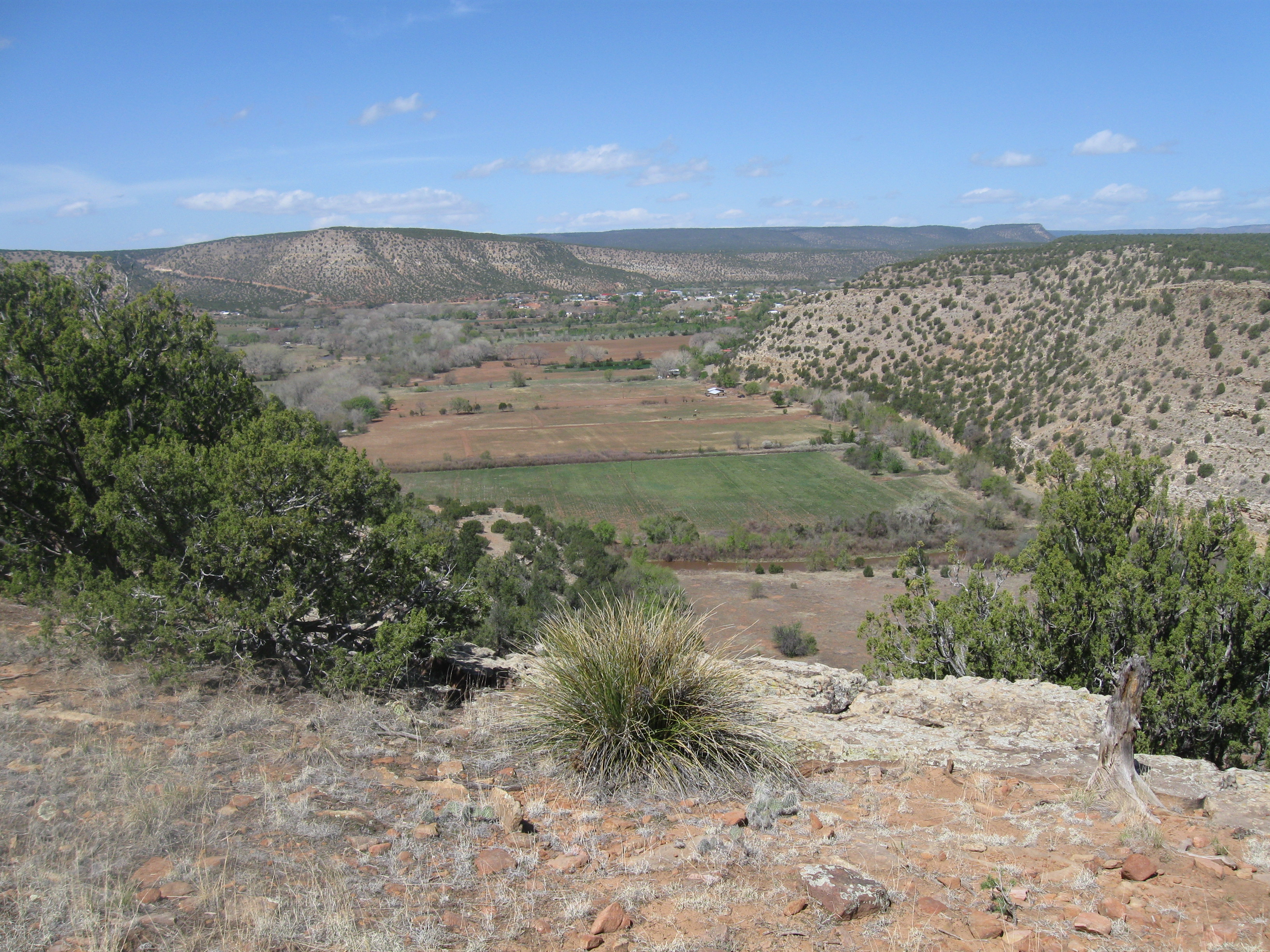
We fired up the old bus, Miss Shelley, for a springtime tour of the land. Up and down mesas, along dirt roads and highways and foot-trails we went, getting a little lost, but even more found.

 A night on the banks of the mighty Pecos river, doves singing in the willows, children playing in the dirt, light falling in unexpected ways, a burst of rain, an old lowrider cruising slowly past the cows.

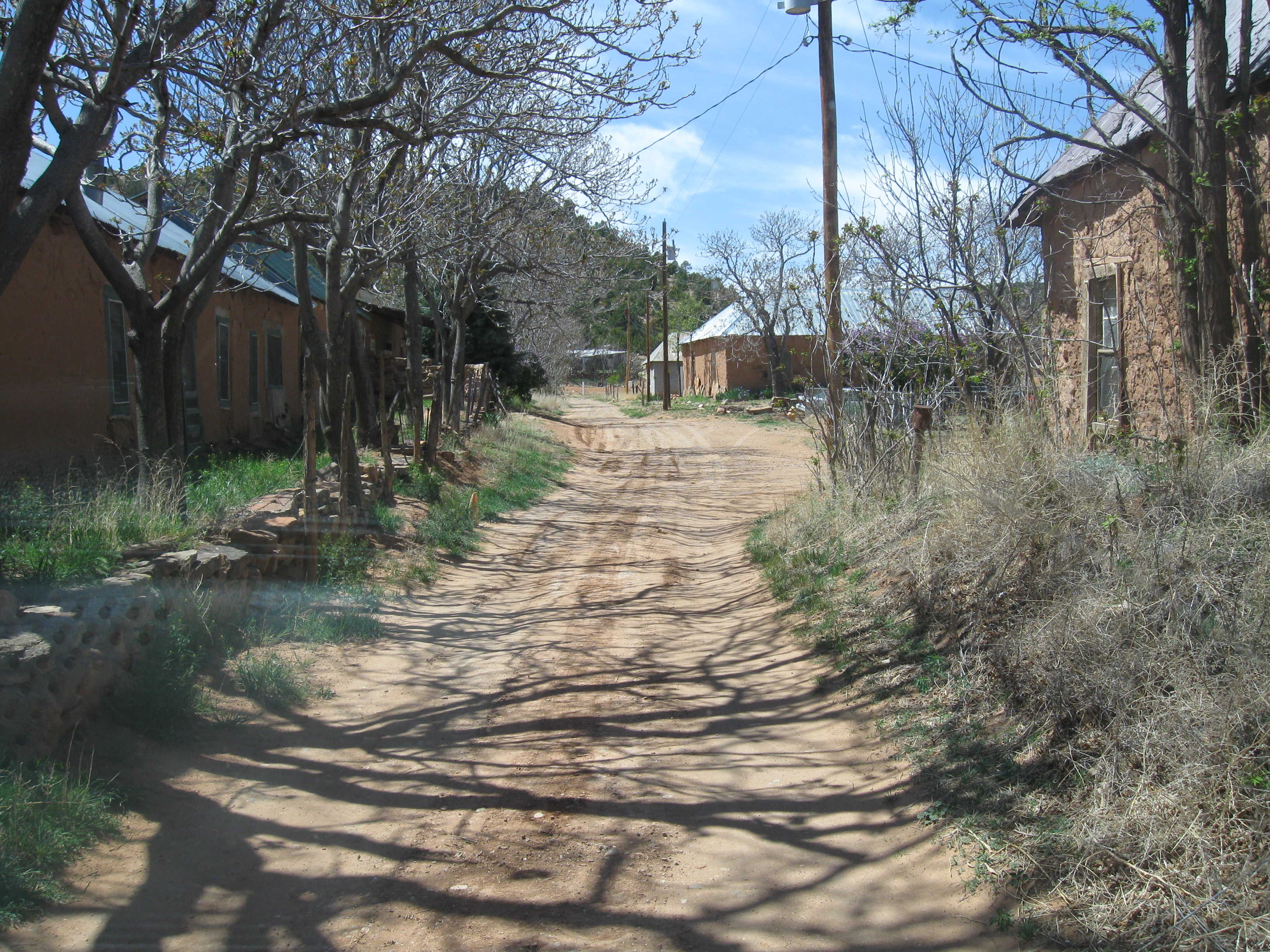
Back in time to the old red rock villages hiding like forgotten gems in the piñon juniper scrub. Past acequias flowing full, and freshly tilled fields flooded with that snowmelt bounty.

We’ve traveled this stretch of land many times, but each time we crest the horizon it is to find the mountains and mesas opening anew, bigger than before. There are layers upon layers of history to peel back, roots to sink deeper, stories to discover and tell.

When we pause to listen and look, or at least travel very slowly (as Miss Shelley loves to do), it all comes pouring forth.

We’re Universe in a Grain of Sand people, my husband likes to say. Oh, New Mexico, you might be sandy, but you are home.

Springtime in the Soul

When I first began to embrace the seasonal celebrations embodied in Waldorf festivals, I was a very ambitious little mama. Armed with my copy of All Year Round and a host of inspiring blogs, I dreamed of making every wonderful project I got wind of. I wanted to do all the crafts and projects at once, to sit down and industriously—but peacefully! Don’t forget the peaceful part—whip out what I felt were the requisite adornments for whatever season we happened to be in.

If it was spring, well, that meant a bevy of flower fairies, wheat grass growing in a basket, eggs died with baths of cabbage and beets and onion skins. Spring meant knitted bunnies, paper windmills and kites, crowns with streaming ribbons in pastel colors, and bright new dresses to sew.

In addition to all this stuff to do there was the songs and fingerplays I wanted to learn, new recipes to try out, Easter and may-day parties to host or attend, and birthday presents to make. Oh, and garden beds to prepare for planting and seeds to start. It all seemed so good, so beautiful and fanciful. With so many possibilities laid out before me I felt compelled, nay, driven, to give it my all.

We live in a world so concerned with productivity and material achievement that it is easy to give myself over to how important and urgent all this feels.

Indeed, all of these things on my to-do list are well and good. Each has its place in bringing beauty and richness to life, to the slowly unfolding days. But to really feel the season moving in my soul, I have to slow way down. Almost to a stop.

When I release myself from that expectation of constant doing, I am able to connect more fully with the inner gesture of the season. From that stillness, I have found that the impulse we all have towards celebration and creativity comes bubbling up naturally enough. Things will get done. Not every thing, but the right things.

And so I’ve learned to chuck the springtime to-do list. Indeed, the natural world is busily taking care of the details—providing the perfect back drop of returning bird song, flowers poking up from the snow, rain bringing thaw and trees bursting into bloom. My dear friend scoffs at the idea of dying eggs. “Our goose just started laying again,” she says. “What could be more magical than that?”

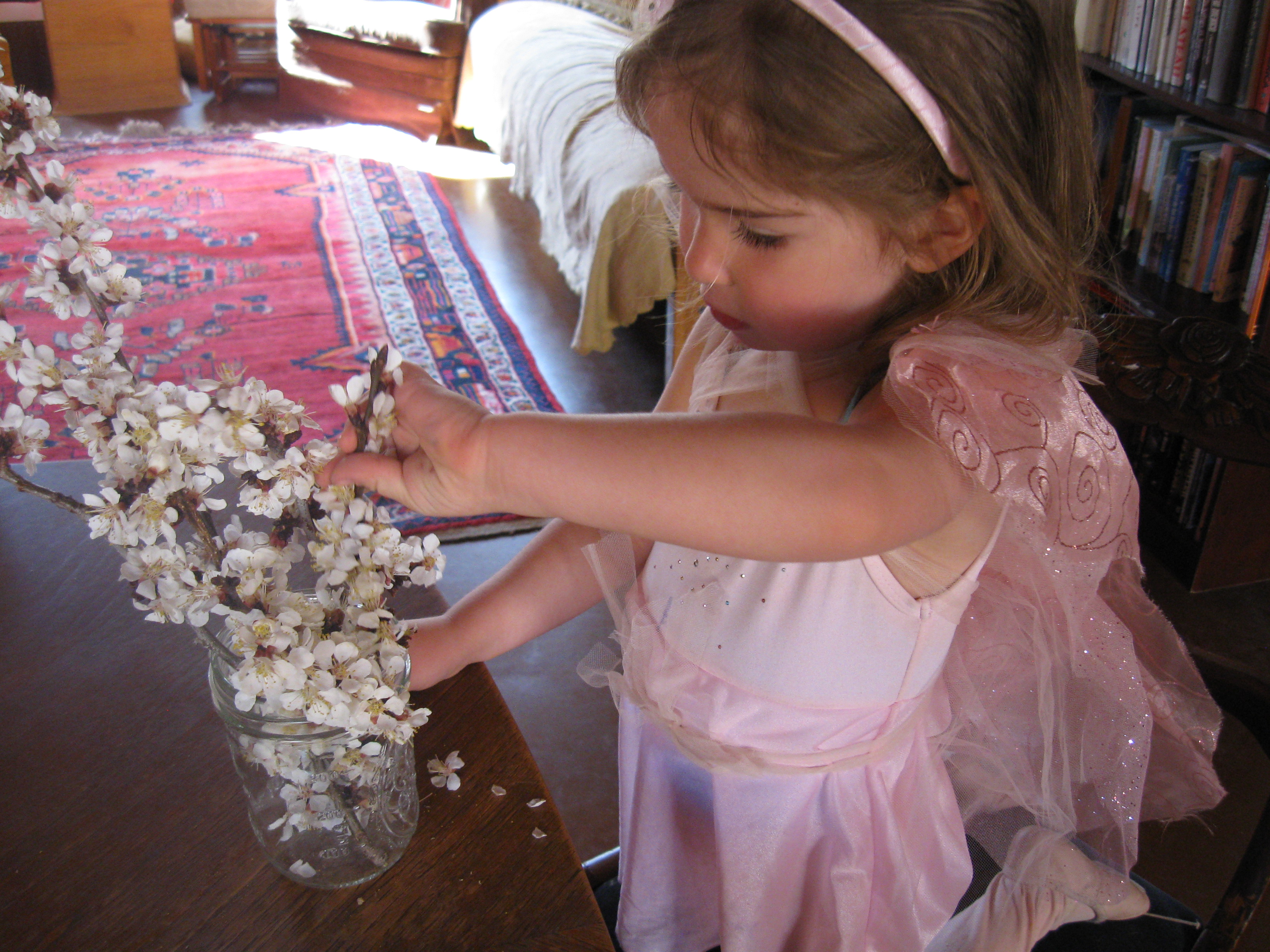
Don’t get me wrong—we will be dying a few eggs. You bet we’ve got a nature table up with a basket of wheat grass and apple branches that refuse to bloom hung with Easter egg ornaments. And this was the year I finally got around to making a flower fairy. These are the small rituals that manifest my inner experience of renewal and beauty. Sometimes they even lead the way, nudging me like any good symbol does, towards the truth that is sometimes unseen.

I am learning, though, that the simpler, the better. That less is so much more. That I can save things for future years. That sometimes, what seems like a lovely idea, is really a big stress. And that my to-do list, no matter how Waldorfy, rushes me through the days, not just of Spring, but this brief season of life with my tiny children. And so I am reminding myself that it’s not simply what I do or make that brings meaning to anything. It is what lives in my heart and fills our days with grace. Attending to that is all I really need to do.

Our very small children are inherently reverent, in awe of the world they have so newly entered, and still connected to the divine place they come from. We can join them in that grace with our presence.

No knitted bunnies required.

Adorning the Birthday Ring

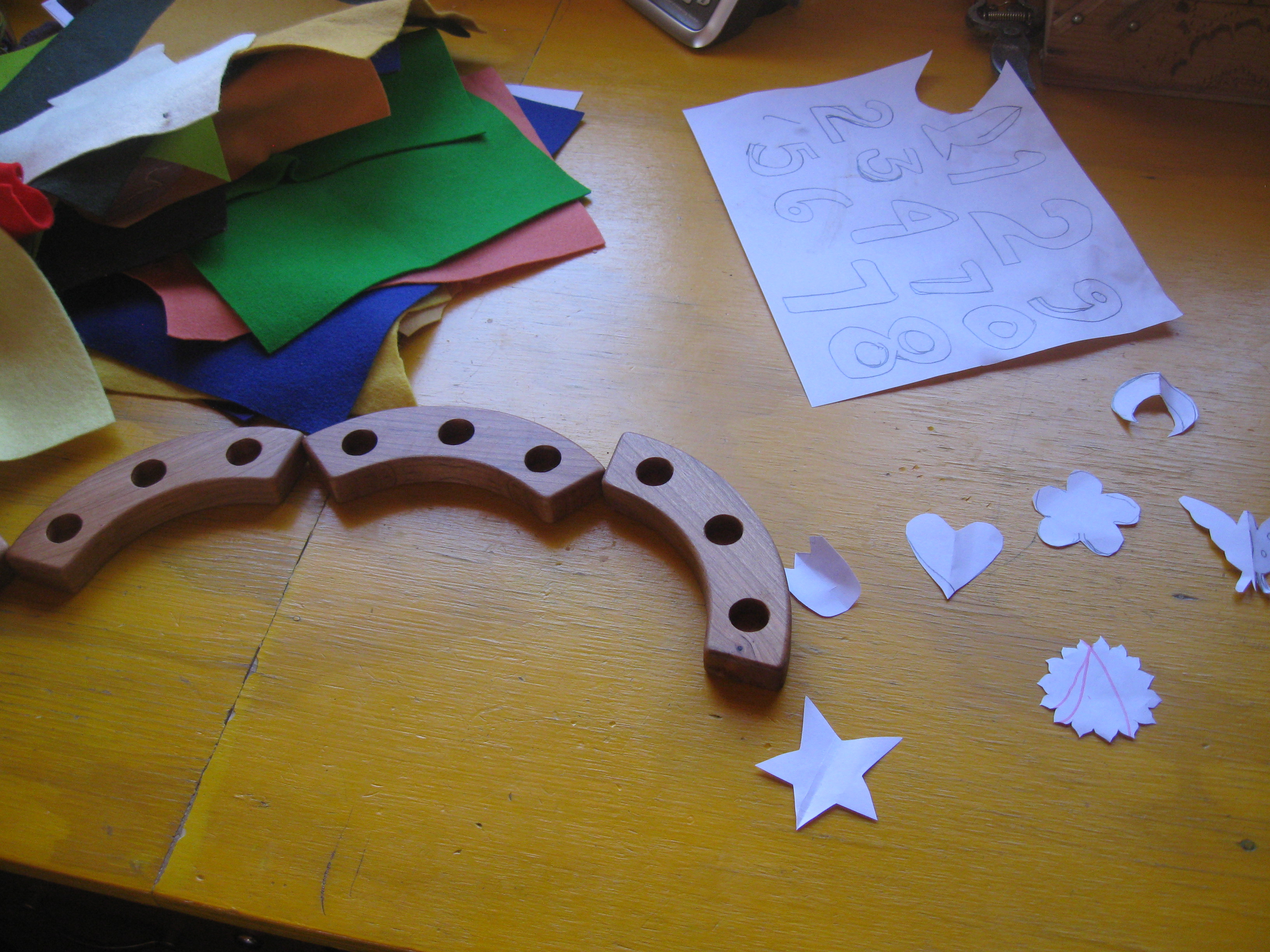
I always wanted one of these charming birthday rings for our birthday table, but the sheer number of parts–and the price tag they added up to–gave me pause. Then a dear friend gave me a spare ring. With a birthday coming, I set to work figuring out how to adorn it for, oh, about five bucks. And I thought some of you might like to hear how I did it.

First, I should say that I did consider buying the decorations, which are wooden and quite charming and no doubt worth the investment. But while bargain hunting (and getting heart burn from the thought of *gasp* buying something ready made) I came upon this tutorial on making your own. I have been in a stash busting mood when it comes to my wool felt collection, and so this was a win-win.

My husband, enrolled as the engineering brains behind this project, found flat mushroom top pegs in one of those many drawers filled with handy little things at the hardware store. They would provide the base for our ornaments. He drilled tiny holes in them to feed 22 gauge brass wire through. The tutorial I linked to above used  3/4 inch dowel sawed to size with a pushpin-made hole to hold the wire. Either way you are looking at some tool use.

Also, the holes in our birthday ring are actually not quite 3/4 inch wide, so there was a bit of sanding to open them up more. Nothing the Man of the Place couldn’t handle, and I probably could have done it too. But I had lady bugs and flowers to cut out.

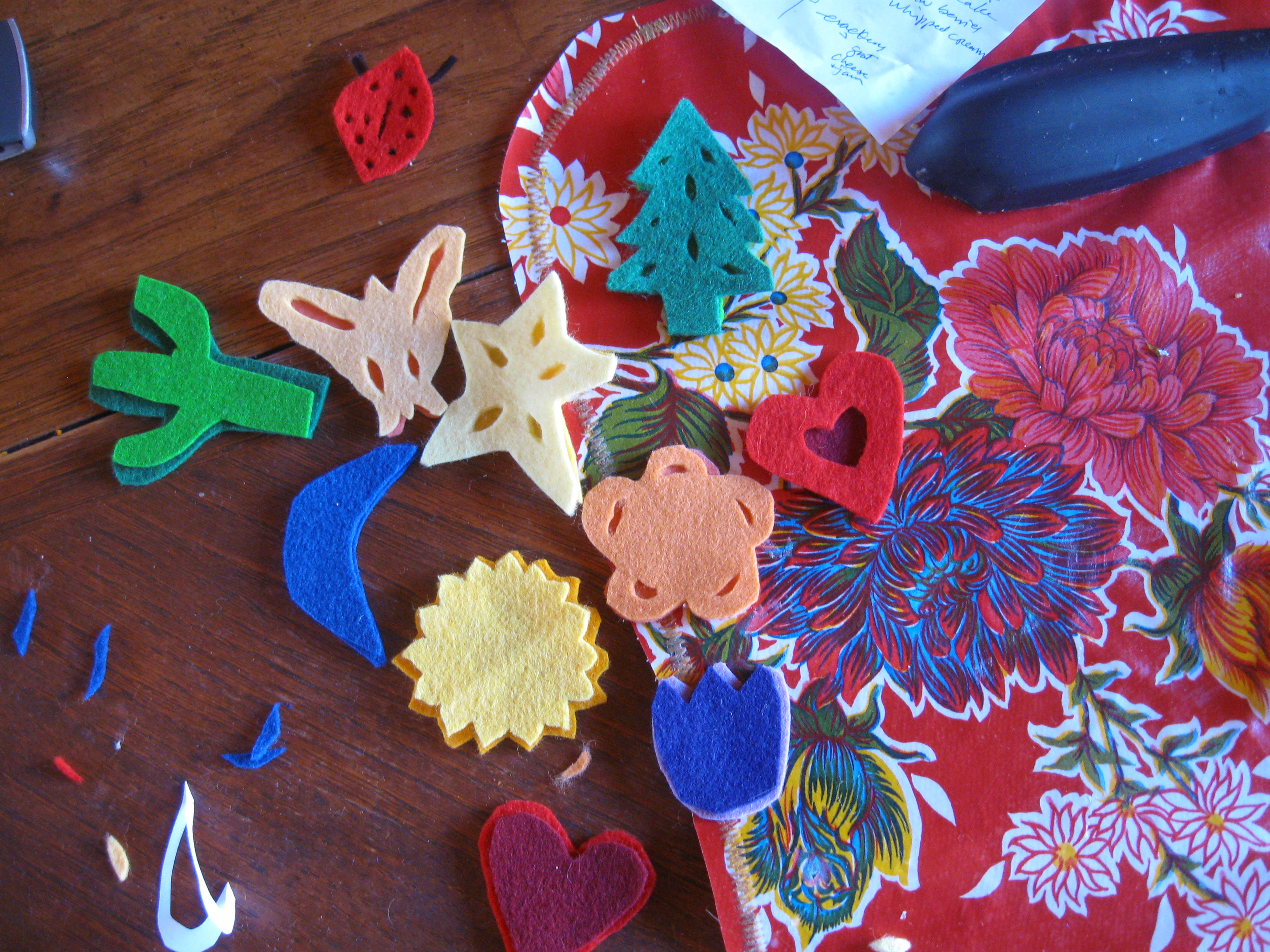
 I used two layers of felt for each symbol, glued together around wire armatures threaded through the peg and bent to the shape of the felt to hold it all in place. We used regular craft glue, and left them overnight to dry.

I recommend keeping the shapes small, and the total height of the ornaments about 4 inches.

Insert sigh of satisfaction and relief.

There is an edge of fire hazard to felted decorations on a candle holder, so use good sense, always keep an eye on it, and if in doubt, blow it out!

The ring and brass candle cups came from here, where you can also buy the wooden decorations and beeswax candles if you like. The wool felt came from here.

Oh, and you could also get super crafty and make decorations for different seasonal festivals…

And lest you think I went totally uber mother for this birthday, let me just say our gift to the little birthday girl was bought new, something that is almost unheard of in these parts and has so far brought all of us joy unfettered by heartburn. Sometimes you just have to know when to spend and when to tap into your inner riches of creative abundance (and too much felt).

Little Love Song to my Firstborn, Now Four.

Little wildflower blooming in the desert. Little drop of honey. Little chickadee singing in the lilac. Little egg still warm in the hand. Little strawberry with cream. Little smiling moon. Little dawn light on the mountain. Little arms around my neck. Little first rain of the year.

Little one, watching you grow into yourself is like watching a flower open, and open, and open again. Each petal unfurling brings us closer to the grace that is our lives, that spiral of love with no beginning and no end. Oh little sweet, how big you really are.

Happy birthday, my heart.

May all good things be yours.

Repairing a Broken World

The hebrew expresion “Tikkun Olam” literally means “to repair the world.” Ideologically it suggests a wholehearted acceptance of the world’s brokenness along with our ability to repair it, or at least our ability to try. It does not point to a particular time or transgression. It does not cast blame. It does not indulge the notion of absolute good or evil. It simply accepts that we live in a broken world and and can, or should (if and when we are ready), reach towards its repair. —Harriet Fasenfest, The Householders Guide to the Universe

I have learned a great deal of humility as I grow in my ability to join our collective repairing of this broken world.

I have at times found myself at a loss to define what “repairing” looks like to me. On the one hand I am impatient with small things like switching to cloth napkins (though please do it if you haven’t yet), and yet it can also take me a very long time to do something as basic as making my own household cleaning solutions. What’s more, as a high achiever, I’m drawn to the dramatic, all or none No Impact Man style changes. Eat only local food! Grow it all! No plastic! Don’t buy anything! No car! Repent!

Sigh.

When our family ended our plastic fast, I felt like a failure for returning to a relatively “normal” life. Still, I knew I had to go in search of balance, and so I surrendered my idea of what I should be doing. I focused my attention on nurturing my family and myself. I learned how to breathe through temper tantrums, to knit and sew, to discover how abundant life on a small single income can be. I carried on with my garden, with milking goats once a week, with hanging the laundry on the line, with building friendships and connection with my community.

I grew and grew and grew.

And the other day I looked around my kitchen and saw that yes, there are plenty of little bits of plastic packaging and such, but actually not very much. We have organically grown away from once ingrained patterns and habits of consumption. While the rules of our fast did foster amazing change and insight in a short period, over the last few years we’ve naturally come to embody that change more fully, more authentically.

For me, a big part of this repair work is an inner repair, one that moves beyond a Type-A Save the World mentality, and towards something infinitely more mysterious.

When we open our hearts to living in a way that strives towards repair, it is our own brokenness that is mended. That must be the first step, for it is our own healing that will guide us to heal the world we inhabit. We have a lot of learning and remembering to do. Just that is enough to fuel our spirits for the good work before us, as we discover the goodness of what it means to create things by hand, to grow things, to lift our voices in song, to really love and nurture, to be whole.

Sometimes it happens by accident. We begin with an action to heal the world, and find ourselves changed for the better. That’s good, too.

Here is something I never thought I’d say out loud: It doesn’t matter what you are doing. It doesn’t matter if you are doing big things or little things, nothing or everything. What matters is that we are all finding our way back to that wholeness. And changing the world from there.

Because I am at home, and it suits my nature, I do what I am doing. Mind the children. Search for beauty. Meet as many of our needs as I can by creating and repairing. Grow a few more vegetables every year, gather herbs from the mountains. Get a little more skilled at all this, a little less awkward. Not worry so much about what other people are or are not doing. Or if anyone is noticing what I’m doing.

So we raise our families and our gardens. We grow out of our radical youths. We may or may not get rid of the car, or have a solar panel array, or ever quite quit plastic. But we do get much better at many things, and also much humbler. Our work of repairing turns out to be about building a new way of life, rather than simply dismantling the old one.

And that will keep us busy for now.

March 11~Head, Heart, and Hands

Thinking:: a great deal about the new cooperative garden being created at the place where we already belong to a goat milking and chicken co-op. I am so excited that I’ve been making excel spreadsheets of seed starting calendars and a rotation for succession planting. As I plan the garden on paper, I am reminded of how other big dreams need to begin with a long gestation and a fair amount of thought. It’s happening in my journal, during conversations on the phone, at power lunches with other mamas with grand visions. Time alone will tell how much of this will flower and what the harvest might be.

Feeling:: full of love for a dear friend who passed away after a life filled with beauty and heart and hope. It is amazing how grief and gratitude can be two sides of the same coin. Feeling grateful for the drip drip of a recent snow melting into our rain barrels, and the hose channeling runoff  to the fruit trees. Feeling happy to be recovered from a day of flu, and also happy to have had a day of rest in which all I did was look deliriously at my children with delight and amazement. Feeling like it’s fine to accept the controlled mess that fills our home. It is a sign of life and joy and creativity. That we live here.

Doing:: deep cleaning, gathering with friends, visiting our favorite wetlands, singing spring songs, planning a birthday party, swapping meals, washing spring greens, and as ever, trying not to do too much of anything at all.

What are your head, heart, and hands up to? Please do tell!

Clean House 1-2-3!

Here is my revolutionary three-step plan to a mess-proof house:

Step 1: Pick up the Mess.

Step 2: Get rid of It.

Step 3: Repeat until the mess is composed entirely of things you can’t live without, or consists of things that are pleasingly wabi sabi in their strewn glory.

I first got hard core about decluttering when I was pregnant with #2. For my birthday that year I told my husband all I wanted was get rid of 1/3 of our possessions. That meant: one teapot, two dozen cloth napkins, forty books, a garbage bag of clothes, a sleeping bag, and on and on. And on.

That was almost two years ago, and I’m still peeling back layers of stuff and excess.

My children charmingly believe that play is basically imaginative emptying of every possible receptacle in the house: cupboards, drawers, toy chest, sewing box, yarn stash, garbage can. I don’t want to keep them from what is no doubt healthy development but nor do I want to have high blood pressure.

So, I’m just getting rid of it all.

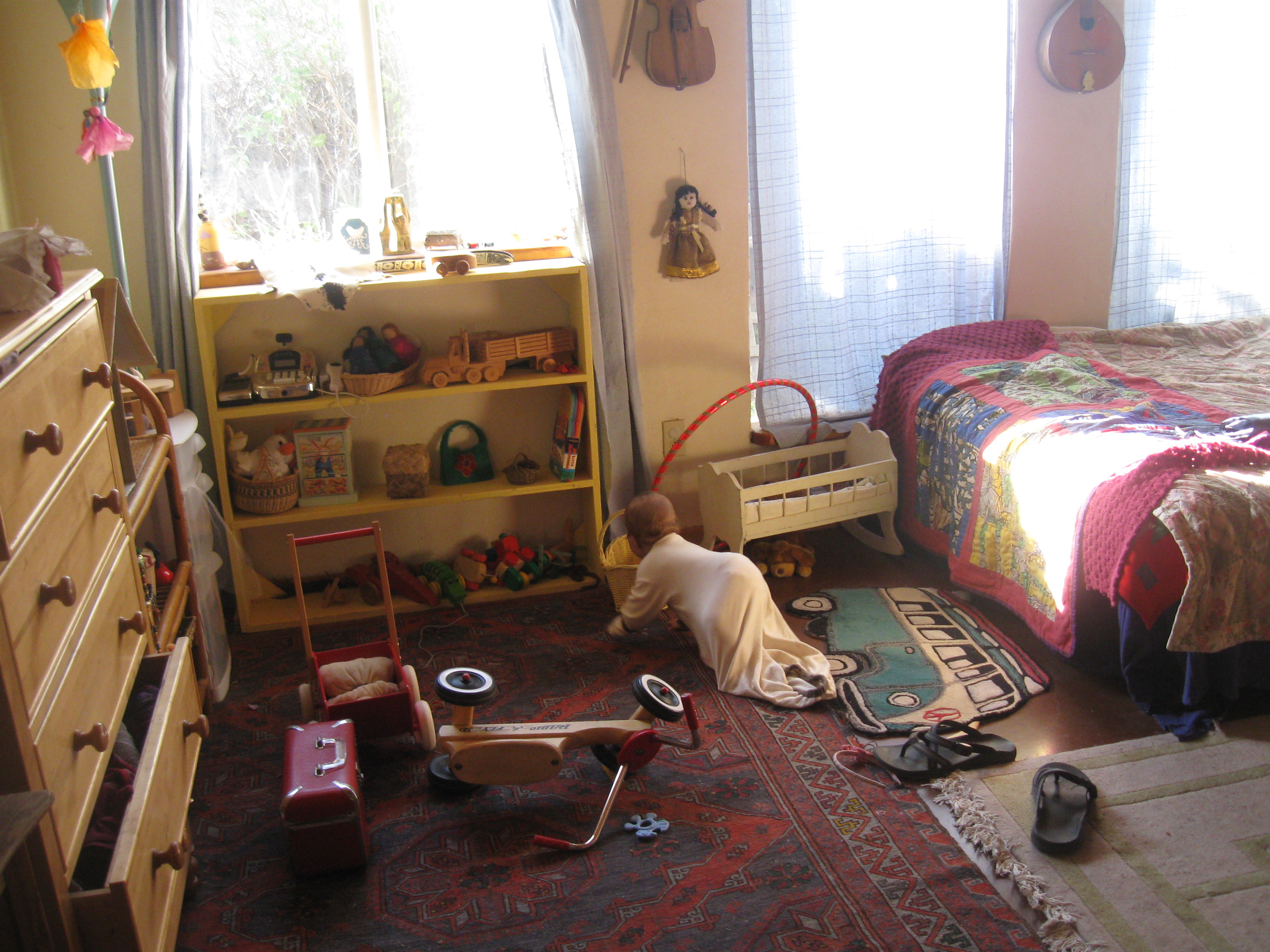
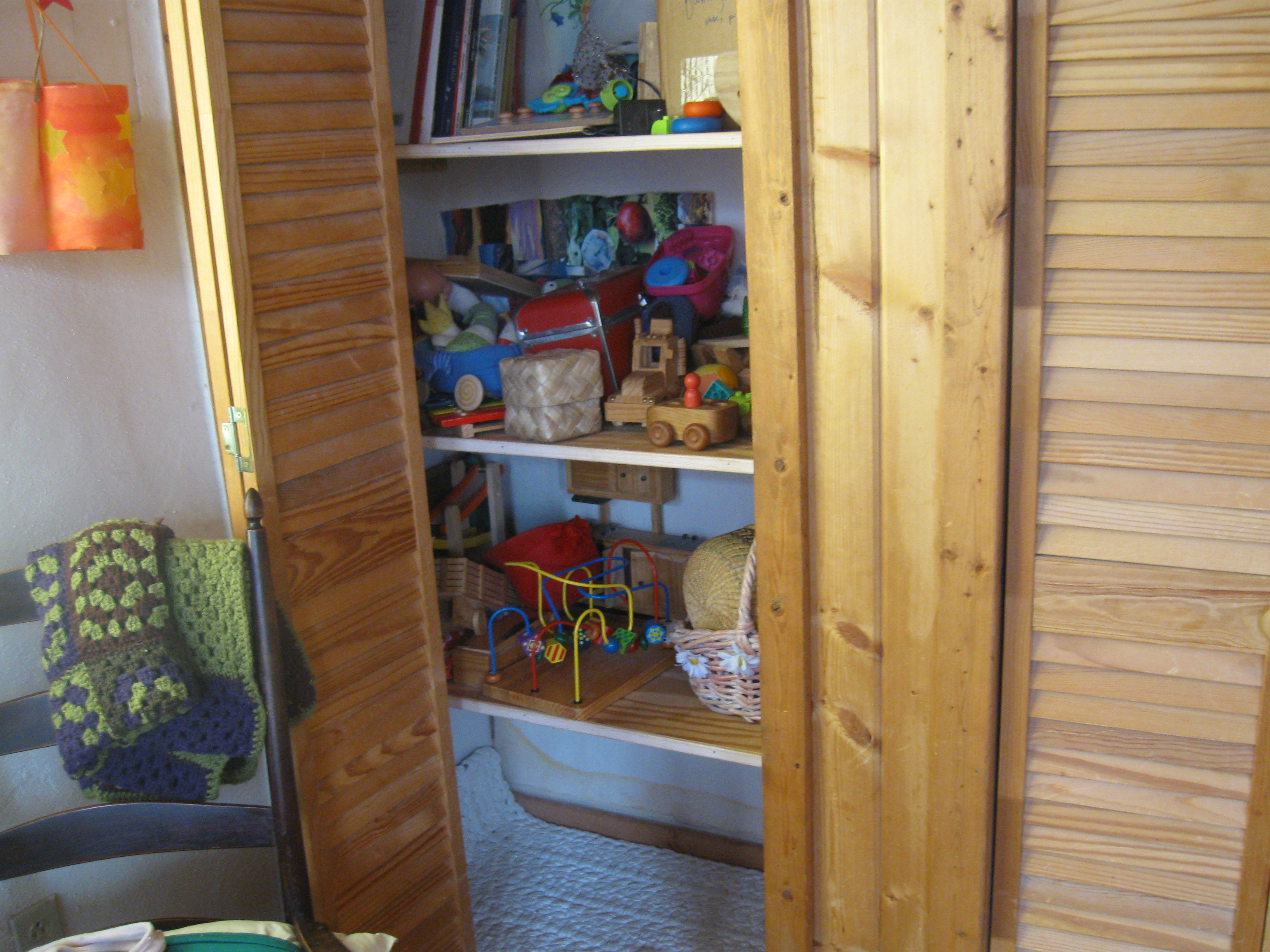
Just curious–does this look like a lot of toys to you, or a little?

A friend of mine is an especially inspiring de-clutterer. She says that she has yet to reach the point where she feels like she’s done enough. I did once get rid of too many spoons, but perhaps it’s a sign that I should pare down on knives and forks.

I de-clutter because it makes my house more beautiful and because it makes my life simpler. The constant picking up and putting away of our detritus takes a tremendous amount of energy from me. Our belongings take mental, physical, and emotional energy to care for. As we get rid of stuff, we are freed in surprising ways.

Where toys go when mama gets tired of picking them up. Visitation is allowed. The bottom floor is kept clear as a hidey hole.

Currently in the Out Box: Anything that annoys me, including, but not limited to

  • Small toys formerly stored in cute baskets. Things that seem to exist for the sole purpose of dumping on the ground and scattering.
  • Play kitchen food and utensils. One or two pots seem sufficient. Food can be found in the real kitchen.
  • Clothing. Out of season clothing, wrong size clothing, excess right size clothing, kid clothing only one or another of the mother-daughter dyad likes, but not both of us. It’s all outta here.
  • Crafting supplies: fabric, yarn, thread, notions. Too much of a good thing is still too much.
  • Books. I have officially reached the point in my Letting Go of Stuff phase where I can part with books. Mostly on the outs are novels and anything I haven’t gotten around to reading despite years of having on the shelf. I’m trying to think of my bookshelves as a curated collection.
  • Children’s books.  We own only a very small collection of special books. The rest come from the library in batches of ten or so at a time. (most of them ones we cycle through repeatedly) ensures that they are all treasured, and enjoyed, not to mention actually read.
Amazing things happen with this bare-bones kitchen.
Wait, there’s more!
  • Animal magnets on the fridge. Under the stove is more like it.
  • Linens–we just don’t need two dozen washcloths, I’ve found. Two sets of flannel sheets per bed keep us cozy year round.
  • Winter clothes. Crafty mamas are in extreme danger of drowning their family in handknits, and we need to help each other be strong against the well meaning onslaught of booties and pilot hats. If you have less of this stuff, you are less likely to lose them in the mountain of gear inside the front closet. Be fearless. And only make it if you really need it.
  • Mama-made toys that don’t get played with. This would be the cardboard barn and hand-knitted menagerie of farm animals, the adorable wee felt folk, the felt balls, the stuffed bunnies, the amigarumi bird family. Perhaps someday when there’s nothing else left, they will be treasured. For now, they are just too hard to dust to keep on the toy shelf.
 I say all this to wish you courage in making your home a place that takes care of you as much as you take care of it. Many blessings on each batch of no longer needed things that moves on to grace another family’s life. Here’s a little chanty for while you work~
Free the heart, let it go.
What we reap is what we sow.
Ps–I noticed Simplemom is in the midst of another Project Simplify. Check it out.

Celebrating a Historic Moment

History was made in Santa Fe, tonight.

I’m fresh from City Hall, where our city council unanimously (and astonishingly) voted in favor of an ordinance guaranteeing water for the Santa Fe River. This makes Santa Fe the first city in New Mexico to make environmental flow in a river law.

To say that this is huge would be an understatement.

At a time when ecological devastation is the norm, this was an act of healing and hope.

It was made possible by a movement that began twenty years ago as a small trickle, and grew into a flash flood of love and support for a dry river that was in 2007 named most endangered river in America. Tonight, City Hall overflowed with citizens, activists, clergy, students, hydrologists, lawyers, ecologists, and yes, the politicians who proved that even against tremendous odds, miraculous things are possible.

Our river was first dammed in the 1880s, and again in the early 20th century. For decades its waters have been held in vast reservoirs and used to supply a growing city. Meanwhile, the river disappeared. It turned into an ugly gash, eroded and trash riddled. A living river was for decades considered folly, a waste of our drinking water. It has been a long road to bring the river back to life, first in our hearts and spirits, (which this little project of mine was dedicated to) and now, in reality.

The vision and activism of our community has worked miracles. It is in many ways a small step–just the beginning, really, of what is truly needed for the river to thrive. But in the face of drought and an uncertain climate future, this is a revolution. It is a step towards recognizing that the rivers future and our own are one and the same.

The Santa Fe River is the thread that stitches us back into the tapestry of the wild, pointing us gently away from destruction and towards conservation.  It is the place where nature, myth, history, and spirit enter our bodies and minds. It carries us now, as it always has. And now we will begin to carry it once again. To take our rightful place as stewards of its well being.

Thank you, Santa Fe. I can smell that wet willow bosque already.

¡Que Viva el Rio!

¡Que Viva Santa Fe!

::

You can read more of the story here.

Walking in Place

Another ski date, this week. Oh, I love when it is perfect, that snow.

Just as good as that was the very ordinary family hike in the foothills this morning. We moseyed along a stream bubbling with snowmelt, the air full with the smell of willow trees before they bloom with spring leaves. Little feet splashing in mud, sliding on ice. Little hands holding our big ones.

And a very special treat was a hike with a friend and her baby (mine were home with papa). So much talking and sharing, so much to say about life and motherhood and marriage. So much sun shining on our faces.

Sometimes it is hard to get out on the land, away from our obligations and the busyness that creeps in even when we are always on guard against it. Sometimes it is a great push (against whining and time constraints, stress and no snack) to claim this space for ourselves and or families. To insist upon it.

It is a holy thing to me, these hours spent wandering our homeland. These mountains have carried us through the seasons–from winter on into spring and beyond, from our free and easy years into the slower footsteps of family life.

When we are planted in place, I’ve noticed, we can’t help but grow.